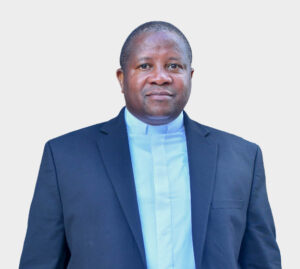
The General Secretariat of Tanzania Episcopal Conference, is composed of the Secretary General, the Directors of Directorates, and any other assistants appointed in accordance and with the statute, By-laws and Rules. The Secretariat is therefore headed by the Secretary General who also carries out the day-to-day activities authorized by the Bishops’ Conference in its Plenary Assembly Meetings, or by the Permanent Council as per statute. It is the Plenary Assembly of TEC that ensures that everything the organization does through the Permanent Council, Committees or Management, supports the vision and mission, and complies with its values.
| TEC Secretary General | ||
|
Rev. Fr. Charles Kitima – Sec. Gen |
Rev. Fr. Furaha – Deputy |
|
The Liturgy Department of TEC falls under the Directorate of Pastoral. It takes care of the Sacred Translation Committee, Sacred Music Committee and Swahili Music Notes Unit. It is headed by the Bishop Chairman and the Executive Secretary. The permanent members of the Liturgy department of TEC are the diocesan liturgical coordinators, liturgy lecturers of the major seminary, universities, and catechetical colleges.
The Liturgy Department plays a vital role in the Catholic Church (at the national and universal levels), serving as the backbone of the Church’s worship and spiritual life. “Liturgy as a prayer is not of human making but rather a creation of God Himself”. This emphasises the department’s significance in preserving and promoting the Church’s liturgical traditions. Therefore, the liturgy department in the Catholic Church is to oversee and facilitate the spiritual and liturgical life of the community by planning and organising celebrations, coordinating liturgical ministries, and providing training and formation. They ensure that public worship, including Mass, sacraments, and other prayer services, is celebrated in accordance with Church guidelines, promoting the full and active participation of all the faithful.
Key Responsibilities
Importance of the Liturgy Department
Conclusion
In conclusion, the Liturgy Department plays a crucial role in the Catholic Church, serving as a guardian of the Church’s liturgical traditions and providing support for the spiritual growth of the faithful. Through its various responsibilities, the department helps to promote unity, preserve tradition, and foster a deeper understanding of the Church’s teachings. As stated in the Catechism of the Catholic Church, “The liturgy is the summit toward which the activity of the Church is directed; it is also the font from which all her power flows.
| Rt. Rev. Simon Masondole | Chair |
| Fr. Clement Kihiyo | Secretary |
The Tanzania Episcopal Conference (TEC) plays a central role in supporting and coordinating the Catholic Church’s evangelization efforts across the country. As the assembly of all Catholic bishops in Tanzania, TEC serves as a unifying body that works hand-in-hand with individual dioceses to spread the Gospel and promote the mission of the Church. Here’s how this collaboration typically works:
TEC provides pastoral guidance and sets national-level priorities for evangelization, ensuring that all dioceses are working in unity while respecting local contexts. Through pastoral letters, strategic plans, and synodal processes, TEC helps dioceses align with the broader mission of the Church in Tanzania.
TEC operates through various commissions and departments, such as:
These bodies create programs, produce materials, and offer training to support diocesan initiatives. They also organize national events like retreats, workshops, and youth gatherings.
TEC trains and empowers catechists, lay leaders, and clergy in different dioceses. This includes:
SCCs are a major tool of evangelization in Tanzania. TEC promotes this model of evangelization, where the faith is lived and shared at the grassroots level. Dioceses implement SCCs locally with materials and training from TEC.
TEC supports diocesan evangelization through Catholic media—radio, TV, and digital platforms. It coordinates with diocesan communication offices to ensure the Gospel reaches the faithful and the broader public effectively.
In dioceses with limited resources or in mission territories, TEC often provides additional support—financial, human, and spiritual. This ensures that even remote communities can be reached with the message of Christ.
TEC also promotes evangelization through social action, guided by Catholic Social Teaching. Through diocesan Caritas offices and justice & peace commissions, TEC helps dioceses evangelize not just through preaching, but also through service to the poor, education, health care, and peacebuilding.
In Summary
TEC and the dioceses work in communion, with TEC offering national leadership, resources, and support, while each diocese brings the Gospel to life in its unique cultural and local context. Together, they fulfill the Church’s mission to “go and make disciples of all nations” (Matthew 28:19).
Most Rev. Isaac Amani
Chair
Lay Apostolate department coordinates Youth Ministry and Family Apostolate. The Biblical Apostolate is coordinated by the Director of Pastoral Services. All commissions have been consolidated into one Coordinator of Committees under the following subsections:
Rt.Rev. Desderius Rwoma
Chair
Rt.Rev. Renatus Nkwande
Chair
The Secretariat, through the Pastoral Directorate is committed to play a leading coordinating role in the renewed push towards new evangelisation, which focuses on deepening the faith through: proclamation / worship communion/fellowship, service and witnessing. In the age of globalization and secularization, this requires new approaches and strategies to reach out to all people of God. This includes the need for greater “inculturation”, i.e. the need to “adapt” Church teachings to prevailing cultures without compromising the specificity and integrity of the doctrines.
In terms of organizational structure, the Directorate is managed by a coordinator who constantly liaises with the Bishop Chairman on substantive pastoral issues before they are brought to the Pastoral Services Committee meeting and the Permanent Council (PC). For daily operations, the Directorate falls directly under the Secretary-General who supervises its activities under the guidance of the Management team to which the Coordinator is a member.
Most Rev Thaddaeus Ruwa’chi
Chair
| Financial Accounting | Rt. Rev. Augustine Shao | Chair |
| Human Resource Management | Rt. Rev. Methodius Kilain | Chair |
| Procurement and Estate | Rt. Rev. Alfred Maluma | Chair |
| Economic Sustainability | Rt. Rev. Edward Mapunda | Chair |
Most Rev Thaddaeus Ruwa’chi
Chair
Rt.Rev. Renatus Nkwande
Chair
Internal Communication
Rt.Rev. Eusebius Nzigilwa
Chair
External Communication
Rt. Rev. Bernardin Mfumbusa
Chair
| Financial Accounting | Rt. Rev. Augustine Shao | Chair |
| Human Resource Management | Rt. Rev. Methodius Kilain | Chair |
| Procurement and Estate | Rt. Rev. Alfred Maluma | Chair |
| Economic Sustainability | Rt. Rev. Edward Mapunda | Chair |
Internal Communication
Rt.Rev. Eusebius Nzigilwa
Chair
External Communication
Rt. Rev. Bernardin Mfumbusa
Chair
Rt. Rev. Flavian Kassala
Chair
Rt.Rev. Renatus Nkwande
Chair
Rt.Rev. Renatus Nkwande
Chair
Rt. Rev. Flavian Kassala
Chair
Most Rev Thaddaeus Ruwa’chi
Chair